
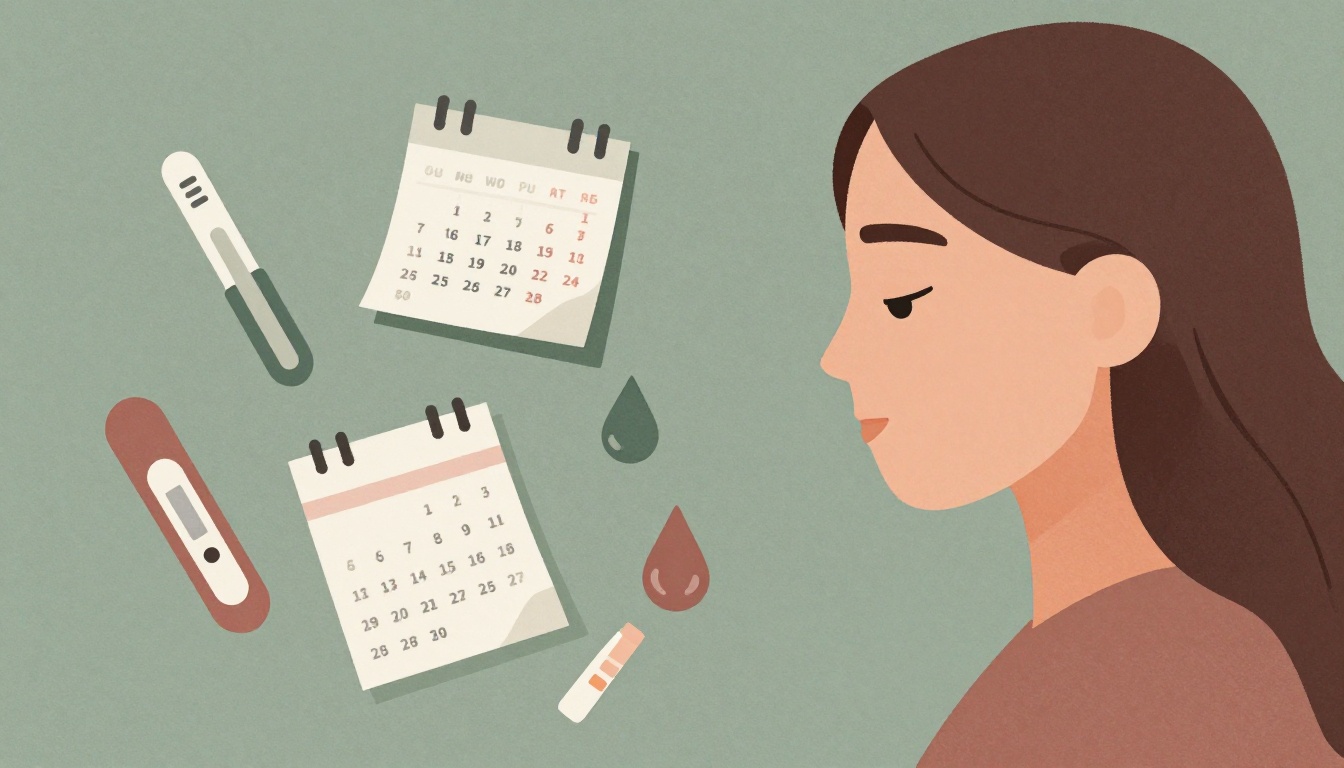
If your menstrual cycles are shorter than 21 days, longer than 35 days, or vary by more than nine days from month to month, you have irregular periods. This unpredictability makes the standard "day 14" ovulation rule useless for you. But you can still identify your fertile window with the right tools and techniques.
Which ovulation tracking method is considered the most reliable for women with irregular periods?
Select one answer.
What counts as an irregular cycle?
A normal menstrual cycle ranges from 21 to 35 days. Irregular cycles include any of the following:
- Cycles shorter than 21 days or longer than 35 days
- Cycle length varying by more than nine days between periods
- Missing three or more periods in a row
- Bleeding that lasts longer than seven days
Common causes include stress, thyroid conditions, polycystic ovary syndrome (PCOS), significant weight changes, and certain medications. If your cycles remain unpredictable for several months, it's worth discussing with a healthcare provider.
Four reliable methods for tracking ovulation with irregular cycles
1. Ovulation predictor kits (OPKs)
OPKs detect the surge in luteinizing hormone (LH) that occurs 24–48 hours before ovulation. For irregular cycles, experts recommend testing more frequently throughout your cycle — not just around day 14. Start testing about five days after your period ends, and test twice daily (around 10–11 am and 4–6 pm) to catch your surge. OPKs are considered the most reliable method for women with irregular periods (source).
2. Basal body temperature (BBT) charting
Your basal body temperature rises by about 0.5–1°F after ovulation due to progesterone. Use a sensitive thermometer that reads to 1/100 of a degree. Take your temperature at the same time every morning before getting out of bed. BBT confirms ovulation after it happens, so combine it with other methods for prediction. A sustained temperature rise indicates ovulation occurred (source).
3. Cervical mucus monitoring
As estrogen rises before ovulation, cervical mucus becomes clear, slippery, and stretchy — resembling raw egg whites. This is your most fertile sign. Check mucus daily by wiping before urinating or by observing discharge on toilet paper. Tracking mucus changes can help you identify your fertile window even when cycle lengths vary.
4. Fertility tracking apps
Apps like Premom or Natural Cycles can log your BBT, OPK results, and cervical mucus observations. They use algorithms to identify patterns over time, which is especially helpful when cycles are irregular. Record data consistently for at least a few cycles to improve prediction accuracy.
When to see a doctor
Consult a healthcare provider if:
- Your cycles remain highly unpredictable after several months of tracking
- You go more than three months without a period
- You experience very heavy bleeding (soaking through a pad or tampon every hour)
- You have severe pain or bleeding between periods
- OPKs show positive LH surges for many days in a row, which can indicate anovulation or hormonal imbalance (source)
Putting it all together: a practical checklist
- Start tracking on day 1 of your period (first day of bleeding).
- Begin OPK testing about 5 days after your period ends, testing twice daily.
- Check cervical mucus daily and note its consistency.
- Take BBT every morning before getting up.
- Log everything in a tracking app or paper chart.
- Look for patterns after 2–3 cycles — your fertile window may shift.
- See a doctor if cycles remain unpredictable or you have concerning symptoms.
How the Resident Expert Can Help
Dr. Jill Palko, founder of Dr. Jill at Your Cervix, offers expert medical writing services focused on OB/GYN content and health communication. Her clinical experience as a physician ensures that your health information is accurate, evidence-based, and tailored to your needs. Whether you're a patient seeking clarity or a healthcare organization creating patient education materials, Dr. Jill can help translate complex reproductive health topics into clear, actionable guidance.